

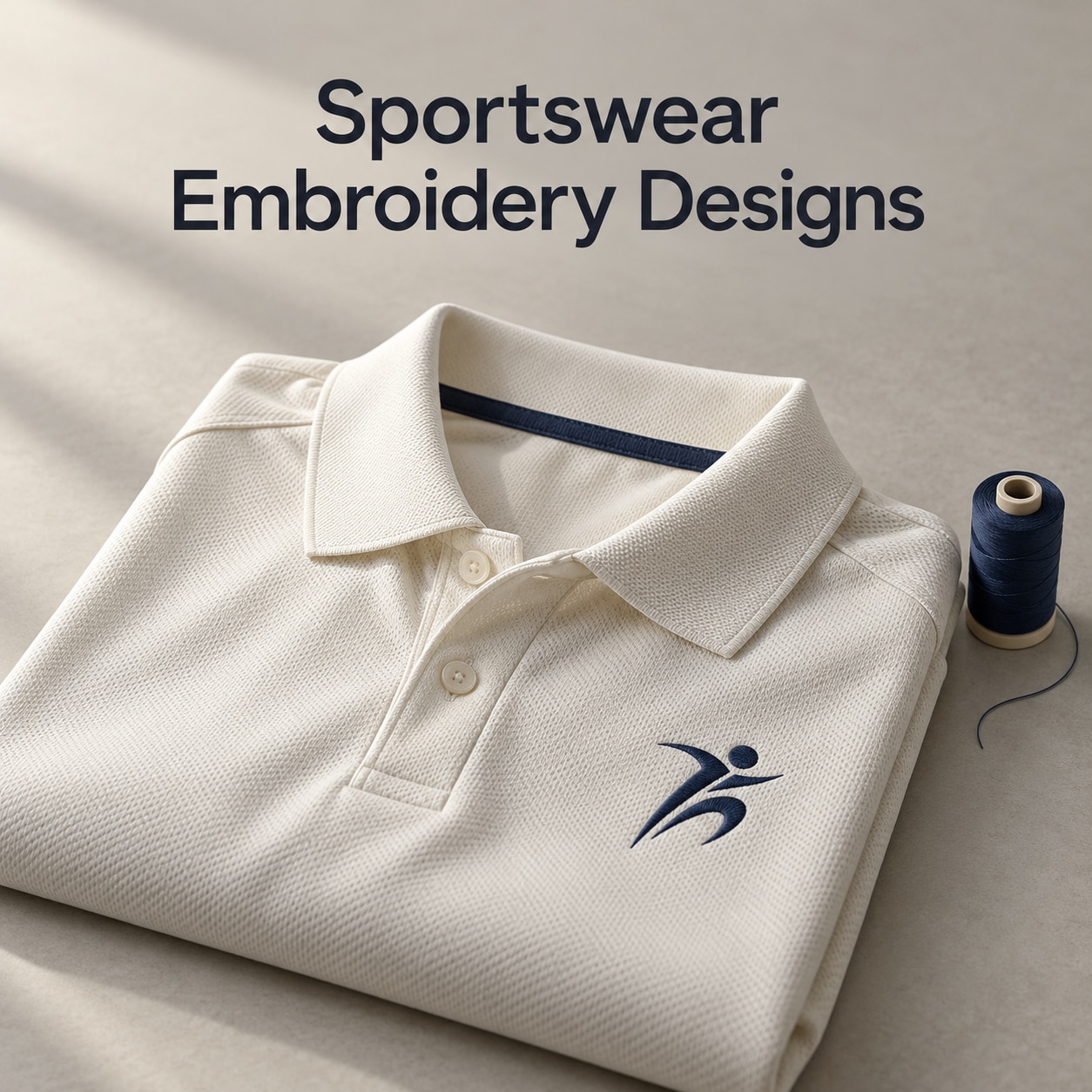
A sports logo cannot move directly from a JPEG or vector file to a jersey: it must be rebuilt as stitch objects that suit the fabric, garment shape, hoop and machine. By following the preparation, sampling and approval stages, you can prevent unreadable lettering, puckering, thread breaks and costly team-order rework.
Key takeaways
- Give the digitizer fabric, garment style, logo size, placement and quantity.
- Use underlay and stitch direction suited to stretch fabric and logo shapes.
- Approve a sewn sample before producing the full sportswear order.
- Compare embroidery, print and providers against fabric, detail and order volume.
Start with production specifications, not just the logo
A digitizer needs production specifications before touching the logo. That is the foundation of the sportswear embroidery design process in Pune and explains how embroidery designs are prepared sportswear in Pune.
1. Hand over editable artwork, finished width and height, garment type, fabric and stretch level, placement, wash conditions, thread system, hoop size, machine brand and required file format. Name the item precisely: polyester jersey, performance mesh, tracksuit, cap or polo.
2. Prefer vector artwork over a JPEG because clean outlines can be enlarged and separated into fills, satin columns, running stitches or appliqué. A vector is still artwork, not an embroidery file. The digitizer must convert it into stitch objects with machine commands.
3. Clean stray points, separate colours, simplify gradients and photographic shading, convert RGB or CMYK colours into thread references, and check outlines against practical minimum line widths. Do not copy a screen preview into production.
4. Treat small lettering as a separate design problem. Redraw letterforms with simpler shapes, wider spacing and stronger strokes; shrinking a large layout can close counters and erase fine lines. Each finished size needs its own layout, including chest, sleeve, shorts and cap versions.
Retain the native editable digitizing file alongside DST, PES, JEF, EXP or another machine format. Machine files carry stitch commands but often lack the editable structure needed for resizing, thread changes or corrections. Capture the approved dimensions, placement and file version before sewing a sample.
Match stitch structure to the fabric and logo shape
A stable stitch plan starts by matching each logo element to the fabric’s movement. Sports logo design preparation in Pune should treat polyester jerseys, dry-fit knits, performance mesh, stretch T-shirts, tracksuits and polos as different substrates, not as one generic garment.
| Logo element | Stitch structure | Best use |
|---|---|---|
| Satin column | Dense, narrow parallel stitches | Borders, slim badges and narrow lettering |
| Fill stitch | Rows covering a broad area | Solid shapes and large colour blocks |
| Running stitch | Single moving line | Fine outlines and small detail |
| Appliqué | Fabric piece secured with stitches | Large colour fields that would become heavy in thread |
Set stitch density, direction, underlay and pull compensation for the actual garment. Edge-run underlay anchors an edge, centre-walk underlay supports narrow columns, and zigzag underlay stabilises wider areas. Excess density or underlay makes a jersey stiff and creates puckering around the logo.
Use cutaway backing for knitted stretch fabrics so the embroidery remains supported after hooping and washing. Reserve tearaway backing for more stable materials. Polyester thread handles repeated washing and abrasion; rayon gives higher sheen but suits less demanding care.
Inspect mesh panels, moisture-wicking finishes, ribbed areas and seams separately because needle support and fabric movement change at each location. A good screen preview is not enough: the stitch plan needs a sewn test on matching fabric.
Set the size, placement and file for each sportswear item
A football jersey, cricket shirt, running vest, track jacket, cap, shorts and performance polo each need a separate finished-size layout. Measure the chest, sleeve, back, shorts panel or cap mark, then keep stitches clear of seams, zippers, ventilation panels and ribbed edges.
This embroidery design workflow in Pune prevents a logo that fits one decoration zone from distorting another.
- Football jersey: set the chest or sleeve mark around the panel shape and avoid side seams.
- Cricket shirt: measure the chest or upper back below the collar, keeping buttons, piping and plackets clear.
- Running vest: use a lighter, compact chest layout that avoids mesh openings and unstable armhole edges.
- Track jacket: check the zipper line, collar and pocket seams before fixing the left-chest or back position.
- Cap: prepare a separate curved-crown file, organised from the centre outward. Do not transfer a flat-garment file unchanged; the cap frame and centre seam alter registration.
- Shorts: measure the front or leg panel and keep the mark away from inseams, hems and elastic ribbing.
- Performance polo: check the chest area around the placket, ribbed collar and moisture-wicking knit.
Team names and player numbers need separate lettering or numbering files, spacing rules and a repeat-production plan. The approval record must state finished width and height, placement measurements, thread brand or colour code, backing, topping where needed, needle specification, hoop and machine format.
Record stitch count, colour changes, trims, appliqué and cap framing because they change production effort.
Use a sewn sample to control stretch-fabric defects
A screen preview cannot reveal thread breaks, registration drift, puckering or needle damage. Sew the design first on the actual garment, or on a swatch with the same knit construction, finish and thickness.
1. Record the first sample’s finished width and height, placement measurements, thread brand and colour codes, stitch count, needle specification, stabilizer, backing, topping, file format and quantity.
2. Inspect registration at colour joins, puckering around dense areas, backing show-through, needle holes, excessive stiffness and distortion. Watch the logo on a moving wearer; lettering that looks clear on a table may close up during movement.
3. Correct the stitch plan instead of approving the screen preview. Adjust stitch density, underlay, stitch direction, overlap, pull compensation, lettering width, trims or sequencing when the sample exposes a fault.
4. Sew the revised sample and compare it directly with the first. Approve only after the defects are resolved and the recorded dimensions and placement match the production specification.
The approved sample then becomes the operator’s reference for hooping, machine setup, colour changes, repeat placement and quality checks across the team order. Separate checks matter when jerseys contain several sizes or decoration zones.
Each sample adds setup and review time, but it is cheaper than removing a distorted chest logo from a finished order. Repeat the test when a supplier changes jersey construction, finish or thickness; the same file can behave differently on a new knit.
Choose the decoration method and provider against the real job
Embroidery is the right choice for a raised, durable sports logo, not for every graphic or fabric.
| Method | Best fit | Avoid when |
|---|---|---|
| Screen printing | Broad, flat graphics on jerseys or teamwear | The design needs individual names or a raised finish |
| Heat transfer | Names, numbers and short runs | You need maximum wash durability across a large order |
| Sublimation | Tonal graphics integrated into compatible polyester | The garment is not suitable for dye sublimation |
| Embroidery | Durable logos, initials and compact branding | The artwork is photographic, highly graduated, oversized, very lightweight or on a highly stretchy panel |
Simplify a complex graphic, use appliqué for a large colour field, or combine methods when full embroidery would create stiffness, puckering or excessive stitch count. Ask the provider to sew the design on the actual garment or an identical fabric swatch; a screen preview cannot reveal registration drift, backing show-through or needle damage.
Before approving bulk work, compare providers using this checklist:
- Approved placement sample, with finished width and height
- Thread brand and colour codes, plus backing or topping
- Garment test showing registration, puckering, stiffness and readability
- Editable native file ownership, revision limits and export to DST, PES, JEF, EXP or the required machine format
- Confirmed hoop capacity, available thread colours and team quantity
Coordinate the sample with your Pune garment supplier, especially for mesh, seams and multiple sizes. Sai Creations Embroidery 08048091422 belongs on the same evidence-based shortlist as any provider that supplies these records before production. Treat the order as a team plan, not isolated garments.
Related services
Embroidery Design Services Sai Creations Embroidery is the best embroidery shop in pune. We provide embroidery services for below customers. View service → |
Computerized Embroidery Job Works Computerized Embroidery Job Works Sai Creations Embroidery is the best embroidery shop in pune. We provide embroidery services for below customers. View service → |
Frequently asked questions
What specifications does a digitizer need before preparing a sportswear logo?
Provide the garment or fabric type, logo artwork, finished dimensions, placement, garment sizes, order quantity, thread colours, deadline and any brand colour requirements.
How do you match embroidery structure to sportswear fabric?
Choose underlay, stitch density and stitch direction for the fabric’s stretch and stability. Use suitable structures for fine lettering, broad fills, borders and curved logo shapes.
Why approve a sewn sample before embroidering all sportswear garments?
A sewn sample reveals puckering, distortion, thread breaks, poor registration and unreadable small details before they affect the full order.
When should you choose printing instead of embroidery for sportswear?
Compare the fabric, artwork detail, surface area, movement, washing demands, order quantity and required finish. Printing can suit large, highly detailed graphics where embroidery would add weight or lose fine detail.
Related services
Embroidery Job Works On Shirt / T Shirt / Garment Embroidery Job Works On Shirt / T Shirt / Garment Embroidery machine operators work with industrial machines to complete embroidery projects. View service → |
Digitizing Embroidery Digitizing Services ₹500 We have been doing embroidery digitization for 23 years. We are one of the best embroidery digitizing service providers in pune. View service → |
Machine Embroidery Job Works What is embroidery job? Embroidery machine operators work with industrial machines to complete embroidery projects. View service → |