

Winter branding fails when a logo designed for a flat shirt is transferred unchanged to fleece, padded jackets, stretch knits, or waterproof shells. By the end, you will know how to specify the garment, select a safe logo position, prepare artwork, approve a sew-out, and preserve consistency across repeat seasonal orders.
Key takeaways
- Match stitch density and backing to each winter fabric.
- Place chest logos away from seams, zips, pockets, and thick insulation.
- Submit artwork, garment details, sizes, colours, and quantities before digitizing.
- Keep the approved thread chart, stitch file, and placement measurements for repeat orders.
Which winter garments and fabrics are suitable for embroidery?
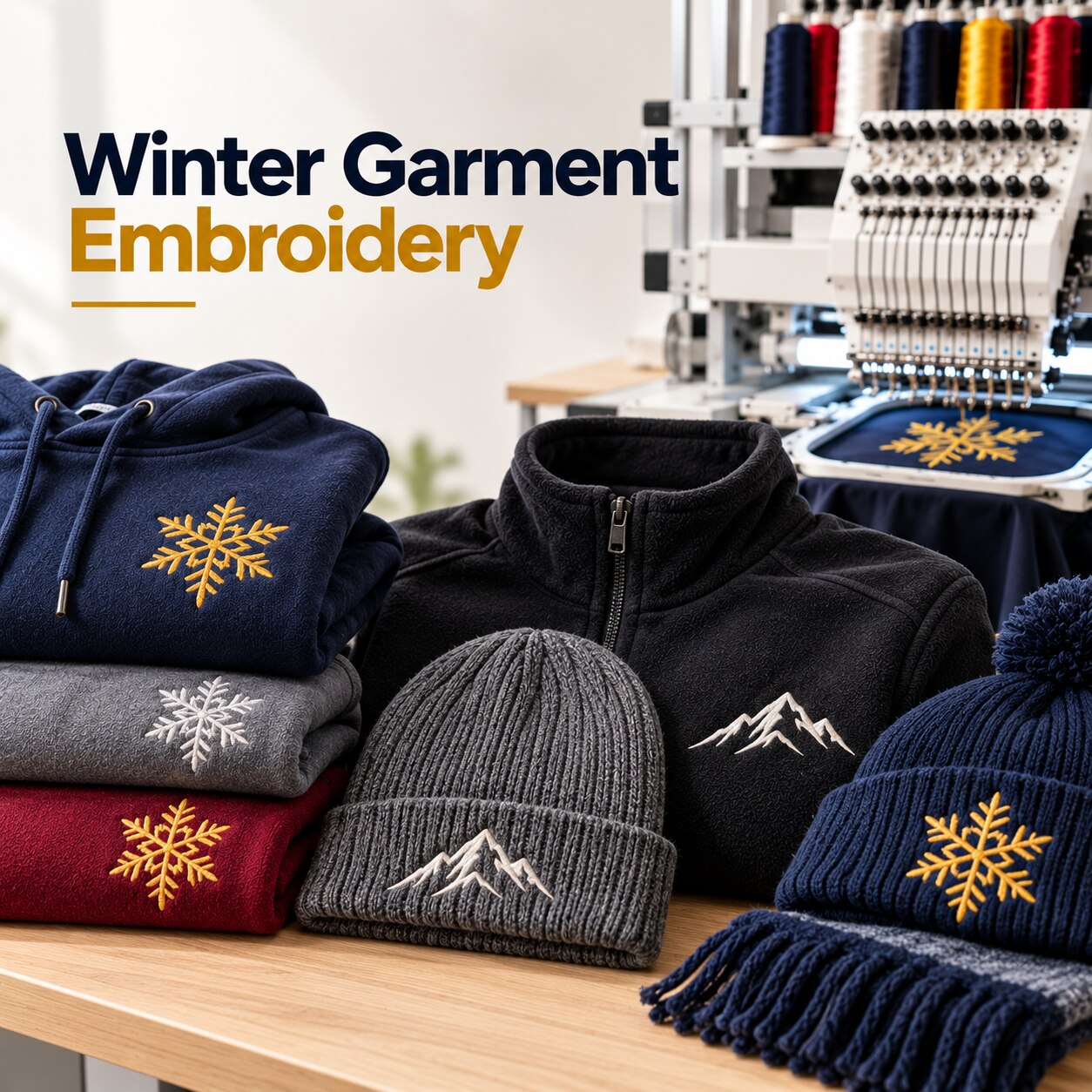
Fleece jackets, sweatshirts, sweaters, hoodies, thermal layers, caps, softshells, quilted jackets, and padded outerwear all suit embroidery, but each needs a garment-specific decision before digitizing. Fleece pile can hide fine detail, stretch knits can pucker, and insulated linings can compress under dense stitching.
| Garment or fabric | Main embroidery risk | What to check before production |
|---|---|---|
| Fleece, sweatshirt knit, sweater, or hoodie | Pile and stretch can swallow details or distort lettering | Use a suitable underlay, controlled density, and a fleece sew-out |
| Softshell or waterproof shell | Dense stitches can create stiffness or perforate a membrane | Test needle choice, stitch load, and membrane protection |
| Quilted or padded jacket | Quilt channels and insulation obstruct hooping and compress fill | Keep clear of seams; consider a separately embroidered badge |
| Thermal layer or ribbed cuff | High stretch and narrow construction can pull the design out of shape | Simplify the mark and test on the actual garment |
| Structured cap or knit beanie | Crown seams, curvature, and stretch require different support | Create a separate cap or beanie file |
A file made for a flat woven shirt can sink into fleece, pucker on stretch fabric, or compress insulation when reused unchanged. Winter garment embroidery in Pune and winter apparel embroidery in Pune therefore require the exact fabric, lining, panel construction, and seam layout in the quotation.
Ask for a physical sample or garment-specific sew-out. A seasonal garment embroidery service should name “fleece jacket” or “quilted padded jacket,” not merely “jacket embroidery,” especially for Pune layering garments and light cold-weather workwear.
Where should a logo go on a jacket, hoodie, or coat?
Place a chest logo from the zipper line and pocket seam, not from the jacket’s total width. That reference keeps the design clear of the opening, storm flap, pocket mouth, seams, rib cuffs, quilt channels, reflective strips, and metal hardware before hooping begins.
- Leave a flat clearance zone around the logo so the needle does not cross a zipper, pocket edge, seam, snap, cord eyelet, or reflective strip.
- Check the inside as well as the outside: lining, insulation, and waterproof membranes can block hooping or suffer needle damage.
- Reserve a broad, uninterrupted fabric area for a back logo; stitching across quilt channels or heavy seam junctions can distort registration and compress padding.
| Position | Practical choice | Main limitation |
|---|---|---|
| Chest | Best for embroidered jackets in Pune, hoodies, and softshells | Measure from zipper and pocket seam |
| Upper back | Strong visibility on coats and work jackets | Needs uninterrupted fabric and clearance from hood seams |
| Sleeve | Useful for a small mark or department identifier | Avoid rib cuffs, articulated seams, and narrow panels |
| Cap front | Suitable for initials or a simplified emblem | Curved, structured panels restrict detail |
Use short names, initials, or simplified marks for small lettering. Fine multi-line text can close under fleece nap and become unreadable after laundering, so request a garment-specific sew-out before production.
For cold weather workwear embroidery, treat safety markings separately. Reflective thread is not certified retroreflective tape; do not replace required tape or compliant visibility markings with a stitched logo. Preserve the garment’s specified background and retroreflective layout.
How should winter embroidery be digitized and stabilized?
Digitize against the actual substrate, not a generic jacket. Fleece pile and stretch require lower-density fills, a light contour underlay, and pull compensation that prevents lettering from narrowing; dense satin columns can sink into fleece or pucker softshell. Select a sharp embroidery needle suited to the fabric and test it on the garment sample.
| Method | Best use | Main caution |
|---|---|---|
| Cut-away backing | Fleece, sweatshirt knits, and other high-loft stretch fabrics | Trim close after sewing; do not tear it, or the garment can distort |
| Tear-away backing | Stable, low-stretch fabrics | Pulling it away can disturb stitches on fleece |
| Adhesive stabiliser | Small areas or awkward panels needing temporary hold | Residue and weak support can cause movement |
| Topping | Fleece pile that could swallow small lettering | Remove carefully after stitching without lifting thread |
| Garment-specific hooping | Seams, pockets, quilt channels, and shaped panels | A flat hoop setup can misalign the design |
Cut-away backing generally preserves registration better on high-loft knits, but excess backing creates a stiff, uncomfortable patch. Use only enough to support the stitch field.
Quilted or padded jackets deserve caution: dense direct embroidery compresses insulation, perforates the shell, and leaves an uneven outline. A separately embroidered badge is safer for a small logo; if stitching directly, use a low-density design between quilt channels.
Structured caps, knit beanies, and flat garments need separate digitized versions. A cap file must respect the crown seam, while a beanie needs simpler stitching that tolerates stretch. These decisions define reliable winter apparel embroidery in Pune and cold weather workwear embroidery.
What information should you submit before a seasonal production run?
Send one complete brief before a seasonal garment embroidery service starts digitizing. For winter garment embroidery in Pune, identify the exact garment construction rather than writing only “jacket.”
- Attach AI, EPS, or SVG artwork. If vector art is unavailable, send the highest-resolution raster file you have.
- State the finished logo dimensions, garment type, fabric, colour, and construction.
- Provide a physical garment or fabric sample, especially for fleece, softshell, quilted, or padded garments.
- Specify thread colours by reference, plus a placement diagram showing measurements from zippers, seams, pockets, cuffs, or panels.
- Give the total quantity, size breakdown, delivery deadline, laundering method, and repeat-order requirements.
- For waterproof shells, ask whether direct embroidery will perforate the face fabric or membrane. Compare direct embroidery with an external patch or heat-transfer marking if weather protection matters.
Request a garment-specific sew-out before production. Inspect puckering, thread breaks, skipped stitches, poor registration, distorted lettering, exposed backing, uneven outlines, and colour changes after the fabric compresses.
Test the approved sample through hot industrial washing, chlorine or oxygen bleach, tumble drying, and repeated abrasion when those conditions apply. Sai Creations Embroidery 08048091422 can document these specifications and approval evidence, but you must retain the approved sample and laundering result for your own checks.
Related services
Embroidery Job Works On Shirt / T Shirt / Garment Embroidery Job Works On Shirt / T Shirt / Garment Embroidery machine operators work with industrial machines to complete embroidery projects. View service → |
Computerized Embroidery Job Works Computerized Embroidery Job Works Sai Creations Embroidery is the best embroidery shop in pune. We provide embroidery services for below customers. View service → |
How do you keep repeat winter orders consistent?
Lock the approved production record before the first winter order ships. Retain the digitized file, stitch count, sew-out, garment style and colour, logo dimensions, placement measurements, thread references, backing specification, needle or stabilizer notes, and final laundering result.
Identify the approval sample by garment construction, not by logo alone. The same file and thread can look different after compression on fleece, softshell, or padded fabric, changing lettering clarity, colour appearance, registration, and durability.
A new sew-out is required when you change:
- Garment brand, fabric weight, lining, or colour
- Logo dimensions or placement
- Washing process, such as industrial laundering or tumble drying
- Garment category, including a cap, beanie, or padded jacket
For caps and garments, keep separate digitized versions where the crown shape, seam, stretch, or usable embroidery area differs. A supplier offering a seasonal garment embroidery service should document these versions rather than reuse one file everywhere.
Supplier comparison is easier when you ask for proof of repeat control:
| Option | What to compare | Why it matters |
|---|---|---|
| Documented setup | Saved file, stitch count, thread and backing records | Prevents size and colour drift |
| Garment-specific approval | Sew-out matched to fleece, softshell, or padding | Exposes compression and lettering problems |
| Production handling | Seam and membrane protection, deadline tracking | Reduces damage and missed seasonal delivery |
For embroidered jackets in Pune, choose the supplier that can reproduce the approved setup, protect seams and waterproof membranes, and meet your required seasonal deadline.
Frequently asked questions
Which winter garments and fabrics are suitable for embroidery?
Fleece jackets, sweatshirts, sweaters, hoodies, thermal layers, caps, softshells, quilted jackets, and padded outerwear can suit embroidery. Choose settings for the fabric: fleece pile can hide fine detail, stretch knits can pucker, and insulated linings can compress under dense stitching.
Where should a logo go on a winter jacket, hoodie, or coat?
Use a flat, accessible area such as the left chest, right chest, sleeve, upper back, or cap front. Keep the design clear of zips, seams, pockets, drawcords, quilt lines, and heavily padded sections.
How should winter embroidery be digitized and stabilized?
Adjust stitch density, underlay, pull compensation, and design size to the garment. Use suitable backing and hooping to control stretch, pile, and compression, then test the file on the actual fabric before production.
What information should you submit before a seasonal production run?
Provide the logo in its best available format, garment type and fabric, size range, garment colours, logo dimensions, placement measurements, thread colours, quantities, delivery date, and any approved sample.
How do you keep repeat winter orders consistent?
Save the approved digitized file, stitch count, thread chart, backing specification, logo dimensions, placement measurements, garment details, and sample approval record. Recheck the first item when the garment or supplier changes.
Related services
Embroidery Design Services Sai Creations Embroidery is the best embroidery shop in pune. We provide embroidery services for below customers. View service → |
Digitizing Embroidery Digitizing Services ₹500 We have been doing embroidery digitization for 23 years. We are one of the best embroidery digitizing service providers in pune. View service → |
Machine Embroidery Sai Creations is one of the best place for Embroidery work in Pune. View service → |
Machine Embroidery Job Works What is embroidery job? Embroidery machine operators work with industrial machines to complete embroidery projects. View service → |