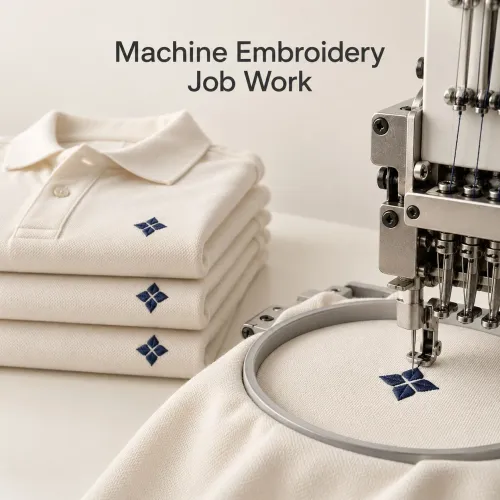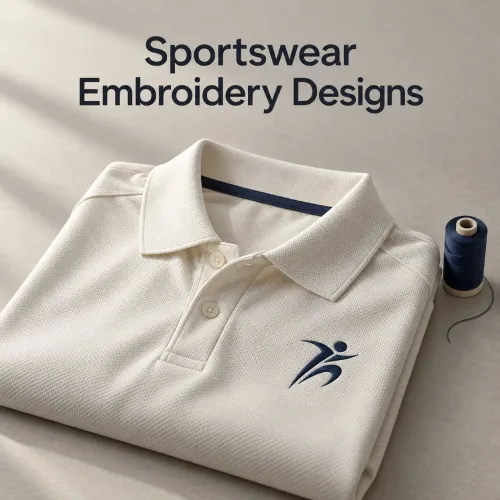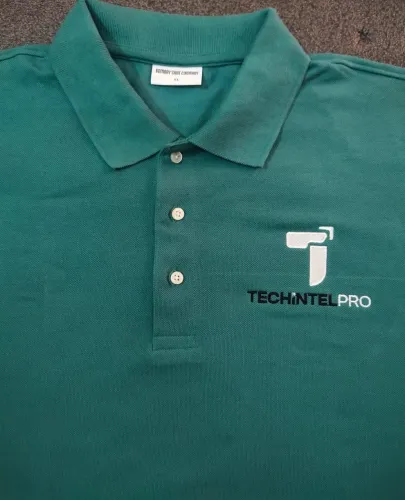


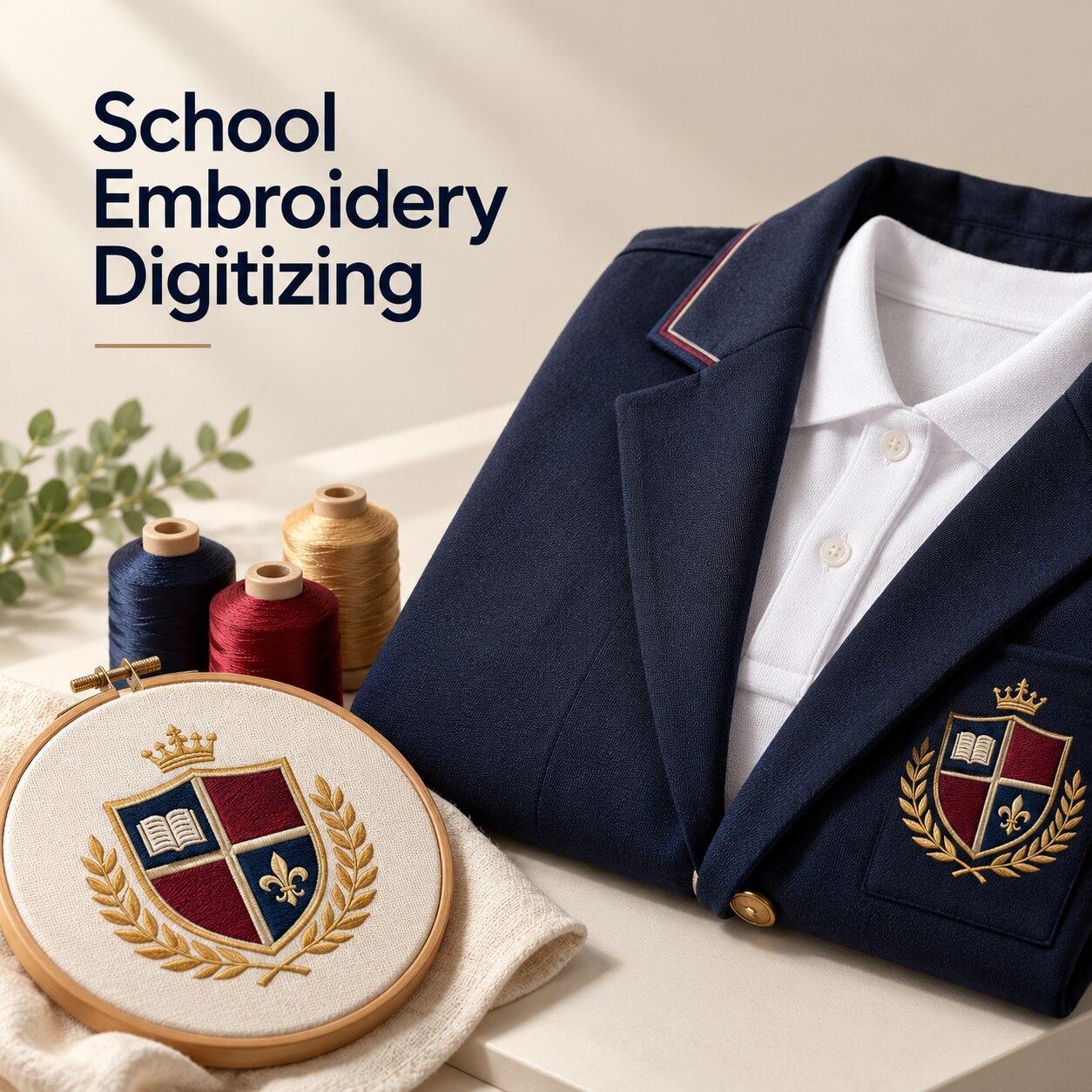
A school logo that looks correct on screen can become unreadable, distorted, or too stiff after it is stitched onto a uniform. Before approving production, you need a complete design brief, the correct machine file, a fabric-specific sew-out, and written standards for colour, size, placement, and washing.
Key takeaways
- List every garment, accessory, placement, and fabric before digitizing.
- Request separate files for badges, caps, small logos, and textured garments.
- Approve stitch samples, thread colours, sizes, and revised files in writing.
- Keep the master embroidery file and restrict changes to approved suppliers.
Which school items need separate embroidery specifications?
List every item that will carry the design before sending artwork: woven badges, left-chest logos, blazers, sweaters, caps, sports uniforms, house badges, school bags, sleeves, and trouser pockets. Do not assume one digitized file will fit them all.
| Item | Why it needs its own specification | What to confirm |
|---|---|---|
| Woven badge or house badge | Fixed badge size and woven construction affect borders and lettering | Finished width, height, colours, and backing |
| Shirt chest or pocket logo | Small areas can make lettering and narrow borders disappear | Separate dimensions and placement |
| Blazer, sweater, or sports uniform | Thick, knitted, or stretchy fabric changes density and underlay | Fabric composition and sew-out |
| Cap front | Curvature, seams, and restricted stitch direction distort borders | Separate cap file and sample |
| Sleeve, trouser pocket, or school bag | Position and available area differ from the chest | Location, dimensions, and size range |
Give the digitizer the school name, logo version, garment colour, fabric composition, logo location, finished width and height, and number of sizes required. Add measurements such as “70 mm below the left shoulder seam” or “centred 90 mm above the pocket”; a photograph alone cannot control placement.
Automatic scaling can make small text unreadable, erase narrow borders, and create excessive density. A school embroidery digitizing service in Pune should identify which items can share a tested version and which need new lettering, stitch directions, underlay, or dimensions. Request the same discipline for embroidery digitizing for schools in Pune.
What must the digitizer change in a school badge or crest?
Require the crest to be rebuilt for embroidery, not merely converted from a JPG or vector file. Shield outlines, narrow borders, small lettering, fine lines, dense fills, and overlapping colours need stitch decisions that a clean screen preview cannot show.
Treat lettering below roughly 4–5 mm cap height as high risk, especially in a narrow sans-serif font. Request a simplified crest when the school name cannot remain legible at the finished badge size.
Ask the digitizer to confirm:
- Underlay, pull compensation, stitch density, and sequencing will control puckering rather than solving distortion by adding density.
- Satin columns around 1.5 mm or narrower can be stabilised; very wide satin areas will be split, structured, or converted to fill when they loop, loosen, or lose coverage.
- Each version will be tested at its actual sewn dimensions.
| Version | Main change to confirm | Typical risk |
|---|---|---|
| Left chest | Balanced lettering, borders, and density | Small text or dense fills distort lightweight polos |
| Sleeve or pocket | Reduced size with revised lettering and satin widths | Automatic scaling makes borders disappear |
| Bag | Construction suited to thicker fabric and larger surface | Excess backing or dense stitches create stiffness |
| Cap front | Separate sequencing and stitch direction for crown curvature | Seams and curvature distort shields and text |
A school badge digitizing in Pune project is complete only after a sew-out remains recognisable at the approved size. The same standard applies to uniform logo digitizing in Pune: approve the sewn result, not an attractive digital preview.
Which files, colours, and approval documents should the school receive?
The school should receive the factory-required machine file before work starts. Ask the uniform manufacturer whether it needs DST, PES, JEF, EXP, or another format; the machine or editing system decides this. A clean JPG or DST preview is not enough for school badge digitizing in Pune.
| Deliverable | What to confirm | Why it matters |
|---|---|---|
| Machine file | Required format, file revision number, final width and height in millimetres | Prevents a supplier from opening or scaling the wrong file |
| Production record | Stitch count, colour sequence, trims, needle changes, and placement notes | Lets every uniform supplier reproduce the approved version |
| Colour record | Physical thread-chart sample or named thread-card references | A DST colour preview usually records stops or sequence, not dependable brand colours |
| Approval proof | Sew-out on the actual garment, reviewed under normal indoor light | Shows colour, registration, lettering, stiffness, and edge quality before bulk work |
Write acceptance criteria into the order for embroidery digitizing for schools in Pune:
- Name the garment type and colour, logo width and height, and placement from named seams.
- Record approved thread references, registration tolerance, visible backing limit, acceptable thread tails, and permitted needle marks.
- Require the school to approve the sew-out before production, and state who pays for revisions when the sample fails.
- Keep the approved artwork, editable file when available, machine files, thread references, measurements, sample approval, and revision history.
That approval record becomes the reference for every uniform supplier using the file.
How will the design behave on each uniform fabric?
A sew-out is reliable only when it uses the actual garment construction, not a similar-looking swatch. Uniform logo digitizing in Pune must account for fabric stability, stretch, thickness, texture, and the way each item will be laundered.
1. Match backing to the fabric. Cotton shirts and stable woven fabrics often suit tear-away backing. Knitted polos and stretch fabrics generally need stable cut-away backing. Polyester blends can reveal registration errors or heat-related distortion, while fleece and textured fabrics may need topping to stop stitches sinking into the pile.
2. Test thick garments separately. Sweaters and blazer material require checks for needle penetration, backing visibility, thread tension, and finished stiffness. A design that looks neat on a shirt can become hard, bulky, or distorted on a heavy blazer.
3. Create a separate cap file. Crown curvature, front seams, the centre-front joining area, and restricted sewing direction can distort borders and lettering. Do not adapt a flat shirt file automatically for a cap.
4. Request a wash trial using the actual thread, backing, garment, and intended process. Test domestic washing, industrial laundry, hot ironing, or bleach exposure when those conditions apply. ISO 3758 care symbols describe care instructions; they do not prove embroidery durability.
Inspect the sample before and after washing for puckering, skipped stitches, thread breaks, colour bleeding, edge distortion, excessive stiffness, and legibility. Record the approved stitch count, dimensions, satin widths, underlay, and pull compensation so every school embroidery digitizing service in Pune works from the same production specification.
How should a school compare suppliers and protect the approved file?
Compare suppliers on production evidence, not a clean JPG, low stitch-count promise, or screen preview. Ask for a sewn sample on the correct garment and compare it with your written acceptance standard: dimensions, placement from named seams, thread references, registration, visible backing, thread tails, and needle marks.
| Supplier evidence | What to compare | Warning sign |
|---|---|---|
| Sewn sample | Correct fabric, colour, size, and laundering result | Sample uses a different garment |
| Production file | Required DST, PES, JEF, EXP, or factory format, with dimensions and sequence | Only a JPG or screen preview |
| Quote detail | Separate charges or inclusions for each production step | One price based only on stitch count |
Your quote should state whether it includes:
- Digitizing, sample sewing, revisions, colour matching, and multiple logo sizes
- Backing, appliqué, cap frames, hoop changes, colour changes, trims, and machine setup
Stitch count does not predict total effort or cost; cap adaptation, extra colour stops, hooping, and sampling can add work. A practical school embroidery digitizing service in Pune should identify which artwork parts need separate files. Sai Creations Embroidery 08048091422 can be compared with other suppliers only after the school requests these deliverables.
For embroidery digitizing for schools in Pune, retain the approved artwork, editable file when available, final machine files, thread references, dimensions, placement diagram, sample photographs, wash-test result, and revision history. Keeping only an exported DST makes later resizing, lettering correction, or cap adaptation harder and can create inconsistent badges between uniform manufacturers.
Related service
Digitizing Embroidery Digitizing Services ₹500 We have been doing embroidery digitization for 23 years. We are one of the best embroidery digitizing service providers in pune. View service → |
Frequently asked questions
Which school items need separate embroidery specifications?
List woven badges, left-chest logos, blazers, sweaters, caps, sports uniforms, house badges, school bags, sleeves, and trouser pockets. Record each item's placement, finished size, fabric, backing, and production method.
What must the digitizer change in a school badge or crest?
Simplify tiny lettering and fine lines, set a stitch-safe border, adjust fill density, and create separate versions for each finished size and garment surface. Do not force one file to work on every item.
Which files, colours, and approval documents should the school receive?
Request the approved machine file for the intended embroidery format, a production reference image, finished dimensions, thread-brand colour names or codes, a stitch-out sample, and written approval identifying the final revision.
How will the design behave on each uniform fabric?
Test the design on the actual woven badge, cotton or polyester shirt, blazer, sweater, cap, sportswear, and bag fabric. Check puckering, registration, lettering clarity, thread coverage, backing, and distortion after pressing or washing.
How should a school compare suppliers and protect the approved file?
Compare sample quality, revision control, fabric testing, turnaround commitments, file formats, and ownership terms. Store the approved master file securely, label its revision, and give suppliers only the production files they need.