

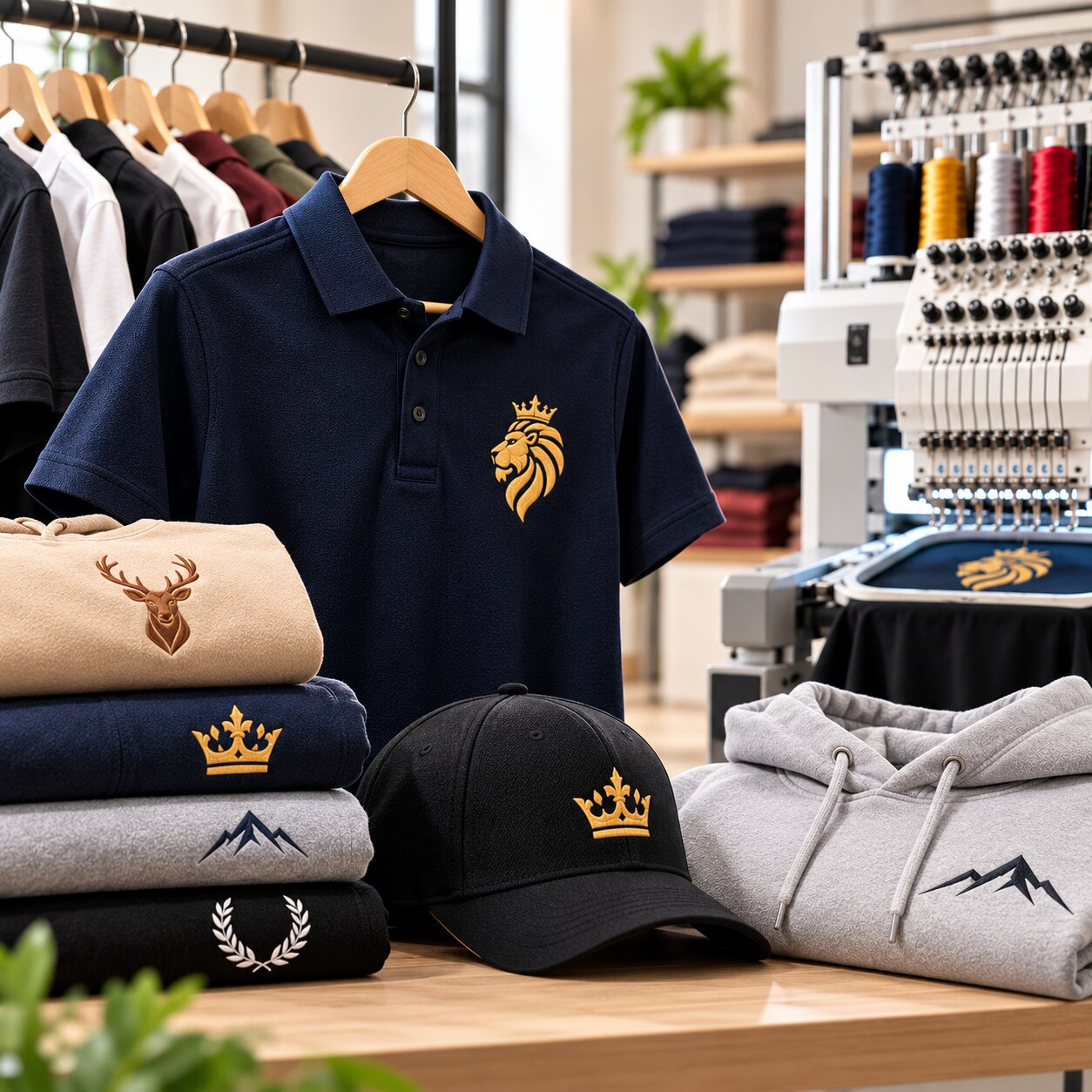
A DST file alone does not tell an embroidery vendor the thread colour, backing, finished size, fabric, or placement needed for reliable production. Before approving a quote, you will need a complete order brief, a garment-specific sew-out, and clear checks for quality, durability, and repeat-order consistency.
Key takeaways
- Send logo files, dimensions, garment details, placement, quantities and deadlines before requesting a quote.
- Request a production-size sew-out and check thread, density, registration and placement before bulk approval.
- Match stitch density, backing and design size to each fabric and garment construction.
- Compare embroidery with screen printing, heat transfer and direct-to-garment for your order requirements.
Prepare an Artwork and Order Brief That a Vendor Can Produce
A quote for computerized embroidery for clothing stores in Pune is only as accurate as the artwork and order brief behind it. Send the vendor this information before pricing:
1. Provide the logo as AI, CDR, EPS or PDF vector artwork. If unavailable, send a high-resolution PNG for reference. Include the finished logo width and height, not only the original artwork dimensions.
2. State the garment composition, colour, size range, quantity by size, maximum embroidery width and height, and whether stitching will be done on cut panels or completed garments. Finished garments can create access problems around seams, zippers and pockets.
3. Add a placement diagram for every application: left chest, sleeve, pocket, back or cap. Mark measurements from the nearest seam, collar, placket or pocket edge; a chest measurement cannot safely be reused for a sleeve or cap.
4. Identify physical thread-card references, the thread fibre, such as rayon or trilobal polyester, and the backing expected. RGB values, hexadecimal codes and screen colours cannot replace a physical thread reference because fibre lustre, garment colour and lighting change the appearance.
5. Treat the DST file as a stitch file, not a complete production specification. It records stitch movements and stops but does not reliably define thread brand, colour chart, needle, backing, hooping or placement. Request a production-size stitched approval sample on matching fabric, then retain the approved sample with the purchase order.
Know What Happens Between Artwork Submission and Garment Delivery
Artwork review comes first: the vendor checks file quality, placement, finished dimensions and garment access before quoting. Approve the written brief, not just the logo, so computerized garment embroidery in Pune is priced against the same job.
- Quotation: confirm locations, finished width and height, garment type, thread and backing, sample charges, trimming, packing, re-hooping and rework terms.
- Digitizing: approve the stitch plan, colours, underlay and pull compensation for each application.
- File editing: confirm corrections to density, lettering, sequencing and trims before the sew-out.
- Sew-out: approve a stitched sample at production size on comparable fabric.
- Production: release the quantity only after the dated sew-out is accepted.
- Finishing: confirm trimming and backing removal, then inspect registration, thread breaks, puckering, loose threads and stains.
- Delivery: check counts, sizes, locations and packing against the order before accepting it.
A flat-shirt file is not automatically suitable for a curved cap. A cap needs a cap frame, centre-out sequencing, stronger underlay, compensation and simplified detail; small lettering that works on a shirt can close up on the front curve.
For repeat apparel embroidery job work in Pune, retain the final edited production file, not only the original logo. Garment, size, thread or backing changes can require a new file.
| Quotation basis | Comparable quote | Weak comparison |
|---|---|---|
| Scope | Locations, dimensions, garment and finishing | Stitch count alone |
| Materials | Thread type and backing | Machine count |
| Labour | Sampling, colour changes, re-hooping and rework | Price per piece alone |
Match the Embroidery Plan to Fabric, Construction and Placement
A cotton shirt and a stretch polo cannot share the same embroidery plan. Fabric stability, garment weight and construction determine backing, hoop tension, access, registration and puckering, so test on the actual bulk garment rather than approving a firm swatch.
| Garment | Main risk | Starting plan |
|---|---|---|
| Cotton shirt | Stable surface; seams and plackets restrict access | Tearaway backing often works; keep chest art clear of seams |
| Polyester uniform | Slippery fabric and heat sensitivity | Test density, underlay and tension on the actual uniform |
| Denim or jacket | Heavy layers and restricted hooping | Check needle penetration, seams, zippers and usable field |
| Fleece | Loft can swallow small details | Use suitable underlay and confirm lettering remains open |
| Knit T-shirt or stretch polo | Stretch causes distortion and puckering | Cutaway backing often supports the design after hoop removal |
| Cap | Curved, structured panel and limited access | Use a separate cap specification, frame and digitized file |
For computerized garment embroidery in pune, measure the usable garment panel, not the machine’s nominal hoop size. Confirm finished width and height, and specify separate dimensions for chest, sleeve, back panel and cap placements.
- Keep chest logos away from pocket openings, collars, plackets, zippers and seams.
- State whether production uses cut panels or completed garments; finished garments create more access and hooping constraints.
- Control hoop tension without stretching the fabric; excessive tension can release into puckering.
- Require a production test for backing choice: stable woven fabric commonly tolerates tearaway, while knits often need cutaway.
For computerized embroidery for clothing stores in pune, oversized artwork may need re-hooping or multi-position work. That creates alignment risk and can leave a visible join, so approve each placement specification before ordering.
Approve a Production-Size Sew-Out Before Releasing the Bulk Order
Release the bulk order only after approving a production-size sew-out. A sew-out is a stitched production-control sample made on fabric that matches the bulk garment as closely as possible; it is not a digital or paper colour proof. It exposes failures before they are repeated across every garment.
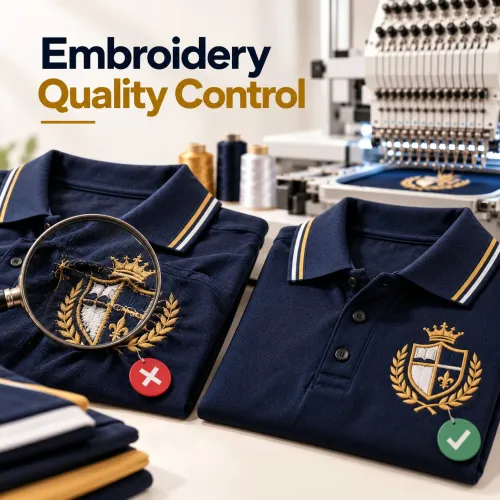
1. Inspect the sample at the actual finished size. Check thread breaks, gaps, poor registration, closed lettering, loose trims, backing visibility, show-through, distorted edges, puckering, fabric distortion and edge pulling. Pay particular attention to small lettering, fine details and narrow columns, which can look clear on screen but become unreadable when stitched.
2. Treat puckering as a construction problem, not only a machine-speed problem. Dense fills, excessive stitch count, weak underlay, unsuitable backing, fabric stretch and poor hoop tension can all pull the fabric out of shape.
3. For uniforms and frequently washed garments, run a wash-and-wear test using the expected care process, such as ISO 6330 domestic washing procedures. After the agreed number of cycles, check colour change, fraying, thread breakage, backing exposure, puckering and registration.
4. Record approval with a signature and date, then retain the approved sew-out with the purchase order. A clothing store embroidery service in Pune or an apparel embroidery job work in Pune should use that physical sample as the reference for bulk inspection, not rely on a DST file or verbal approval.
Compare Embroidery With Other Decoration Methods and Compare Vendors Properly
Choose computerized embroidery when you need raised, durable branding on shirts, uniforms, jackets, caps, or structured apparel. Printing wins for large photographs, gradients, and very fine colour detail.
| Method | Texture and durability | Colour and artwork detail | Quantity and garment suitability |
|---|---|---|---|
| Embroidery | Raised; highly durable | Limited thread colours; logos and lettering | Small or large runs; shirts, uniforms, jackets, caps |
| Screen printing | Flat; durable with proper curing | Strong solid colours; less suitable for gradients | Better for repeat runs and large designs on flat garments |
| Heat-transfer vinyl | Smooth or slightly raised; moderate durability | Few colours; clean text and simple shapes | Low quantities; tees, jerseys and smooth fabrics |
| Direct-to-garment | Soft printed surface; wash durability depends on ink and care | Excellent gradients, photographs and fine detail | Small runs; cotton-rich light garments |
| Woven labels or patches | Tactile, separate component; durable when sewn well | Fine woven detail, but limited by label size | Small or large runs; hems, pockets, jackets and accessories |
For a clothing store embroidery service in Pune, compare written specifications, not machine count or price per piece. Trims, colour changes, re-hooping, cap handling, appliqué preparation and finishing change labour; stitch count alone is incomplete.
Ask each apparel embroidery job work in Pune provider for:
- Machine head count, actual usable field, turnaround, digitizing method and sample approval
- Rayon or trilobal polyester thread, backing choice, garment handling and order tracking
- Rework terms and retention of the final edited production file for repeat orders
Evaluate Sai Creations Embroidery 08048091422 using the same brief and approved sample as every competing quote for computerized embroidery for clothing stores in Pune.
Related services
Computerized Embroidery Job Works Computerized Embroidery Job Works Sai Creations Embroidery is the best embroidery shop in pune. We provide embroidery services for below customers. View service → |
Embroidery Design Services Sai Creations Embroidery is the best embroidery shop in pune. We provide embroidery services for below customers. View service → |
Frequently asked questions
What information should a clothing store include in an embroidery order brief?
Provide the logo or artwork, finished design dimensions, garment type and fabric, placement, thread colours, order quantity, size breakdown, deadline and any required sample. These details let the vendor quote production accurately.
What happens after artwork is submitted for computerized embroidery?
The artwork is digitised into machine-readable stitches, checked for thread sequence and density, sewn as a sample, reviewed for size and placement, then released for bulk production after approval. Garment delivery follows the agreed production and finishing schedule.
Why is a production-size sew-out important before a bulk order?
A sew-out shows the actual stitch coverage, thread colour, edges, lettering clarity and fabric interaction at the ordered size. Approve it only after checking placement on the real garment, because a screen preview cannot reveal puckering or distortion.
How should a store compare embroidery vendors and other decoration methods?
Compare digitising fees, sample policy, minimum quantity, turnaround, rework terms, thread options and quality controls. Choose embroidery for durable raised branding, but compare screen printing, heat transfer and direct-to-garment when the design, fabric, quantity or budget suits them better.
Related services
Machine Embroidery Sai Creations is one of the best place for Embroidery work in Pune. View service → |
Embroidery Job Works On Shirt / T Shirt / Garment Embroidery Job Works On Shirt / T Shirt / Garment Embroidery machine operators work with industrial machines to complete embroidery projects. View service → |
Digitizing Embroidery Digitizing Services ₹500 We have been doing embroidery digitization for 23 years. We are one of the best embroidery digitizing service providers in pune. View service → |
Machine Embroidery Job Works What is embroidery job? Embroidery machine operators work with industrial machines to complete embroidery projects. View service → |